


GHK-CU 50mg
GHK-CU 50mgSKU#: SKU:GHK50-073
⭐ Rated 4.6★ on Trustpilot
Couldn't load pickup availability
Do you need Bacteriostatic Water with your order – Click here to add.
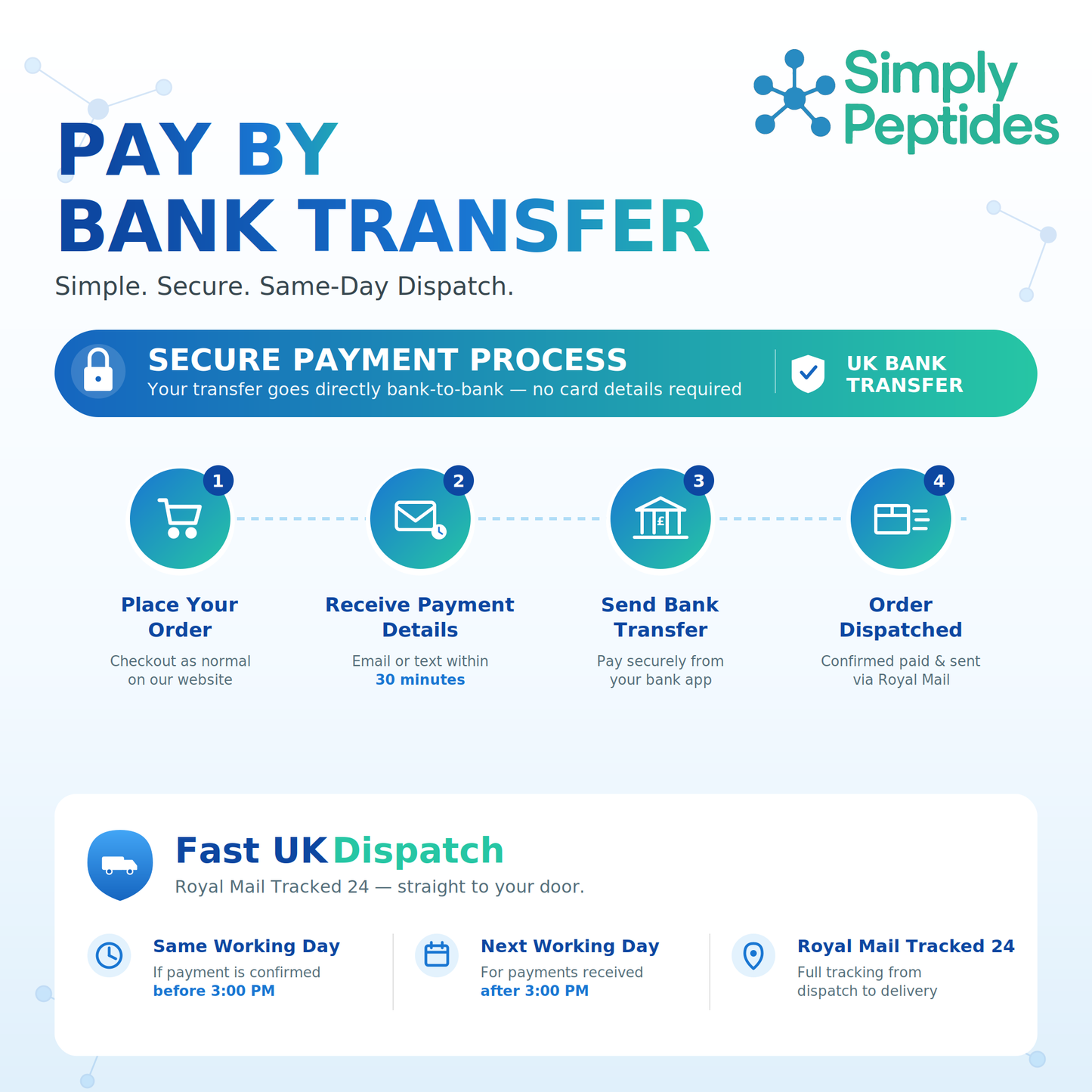
We currently only accept payment by bank transfer, find out more here.
View full details
Free & Fast Shipping
Orders placed by 3pm are shipped the same day.

Secure Payment
We guarantee that the payments are 100% secure.

Research Use Only
Our Peptides are intended for research use only.


GHK-CU 50mg — Copper Peptide
GHK-CU (Copper Peptide) is a naturally occurring copper complex of the tripeptide glycyl-L-histidyl-L-lysine. It is supplied strictly for in vitro laboratory research and scientific study. This compound is not intended for human or veterinary use and is not a dietary supplement or medicinal product.
Why Choose Simply Peptides for GHK-CU in the UK?
Simply Peptides is committed to providing research‑grade compounds of uncompromising quality. Through direct manufacturing partnerships, we maintain full oversight of production standards and batch consistency. Researchers across the UK and internationally trust our transparent testing, rigorous quality control, and dependable supply chain.
- ✅ ≥99% purity verified by HPLC and Mass Spectrometry
- ✅ Manufacturer COAs inspected and available for every batch
- ✅ Independent third-party COA available on batches marked as with Independent COA
- ✅ Same-day dispatch on orders before 3pm — Royal Mail 24hr Tracked
- ✅ UK-based supplier with direct manufacturing partnerships
- ✅ Rated 4.5★ on Trustpilot
Product Specifications & Storage
- Product Name: GHK-CU 50mg (Copper Peptide)
- Molecular Formula: C14H24CuN6O4
- CAS Number: 89030-95-5
- Molecular Weight: 403.92 g/mol
- Amino Acid Sequence: Gly-His-Lys (complexed with copper)
- Purity: ≥99%
- Compound Type: Copper Peptide Complex / Tripeptide
- Form: Lyophilised Peptide Powder – What is this? Read more here.
GHK-CU is supplied as a lyophilised peptide powder. Reconstitution requires Bacteriostatic Water, available separately. For best results, follow our website's detailed reconstitution and storage guidelines.
Learn more about peptide storage and reconstitution
About GHK-CU as a Research Compound
GHK-CU is a naturally occurring copper complex first isolated from human plasma. It has attracted significant research interest due to its involvement in multiple cellular signalling pathways related to tissue remodelling, wound biology, and gene expression regulation. In preclinical and in vitro models, researchers have investigated its role in a broad range of cellular mechanisms.
Published scientific literature has examined GHK-CU in the following research contexts:
- Collagen and extracellular matrix research — studied in fibroblast models examining collagen synthesis and tissue remodelling pathways
- Wound healing biology — investigated in preclinical models of cellular migration and tissue repair mechanisms
- Antioxidant pathway research — examined in studies on superoxide dismutase activity and oxidative stress defence mechanisms
- Gene expression regulation — researched in models examining GHK-CU influence on multiple gene expression pathways
- Angiogenesis research — studied in models examining vascular endothelial growth factor related signalling
- Anti-inflammatory signalling — investigated in cellular models of cytokine regulation and inflammatory pathway modulation
All research findings referenced above are derived from in vitro and preclinical studies. No clinical claims are made or implied.
Synthesis and Quality Assurance
Our GHK-CU is synthesised using controlled manufacturing processes designed to ensure high purity, structural accuracy, and batch‑to‑batch consistency. Each batch undergoes stringent purification and analytical testing, with results documented in our COA and testing reports.
Related Research Compounds
Researchers working with GHK-CU may also be studying these related compounds available from Simply Peptides:
- GHK-CU 100mg — larger quantity of the same compound for extended research programmes
- BPC-157 5mg — studied in tissue repair and cellular regeneration models
- TB500 5mg — researched in cellular repair and regeneration pathways
- Epitalon 10mg — researched in telomere biology and longevity studies
- Bacteriostatic Water 10ml — required for reconstitution of this compound
External Resources for Researchers
Alternative Names for GHK-CU
- Copper Peptide — common research name
- Glycyl-L-histidyl-L-lysine copper — IUPAC name
- GHK:Cu — alternative notation
- Copper Tripeptide-1
Frequently Asked Questions
-
GHK-CU is studied in laboratory settings for its role in collagen synthesis, wound healing biology, antioxidant pathways, gene expression regulation, and anti-inflammatory signalling. All use is strictly in vitro and for research purposes only.
-
Our GHK-CU is verified at ≥99% purity via HPLC and Mass Spectrometry, with a Certificate of Analysis available for each batch.
-
GHK-CU is supplied as a lyophilised powder in a sealed vial. Bacteriostatic Water is required for reconstitution and is available separately. Store at -20°C prior to reconstitution.
-
Yes. All UK orders are dispatched via Royal Mail 24-Hour Tracked & Recorded. Orders placed before 3pm are shipped the same day.
Legal and Safety Information
Simply Peptides supplies GHK-CU strictly for in vitro scientific and laboratory research use only. This product is not intended for human consumption, veterinary use, or clinical application. It is not a supplement, drug, or food product, and has not been evaluated or approved by the MHRA or any other regulatory authority. We uphold stringent quality and legal compliance standards to support the research community.